


REX CEMENT STOP
The expandable cement stop
- No cement leakage
- Resists high pressure without migration
- Expands at specific depth
- Bioresorbable
- Five sizes to cover all canal diameters
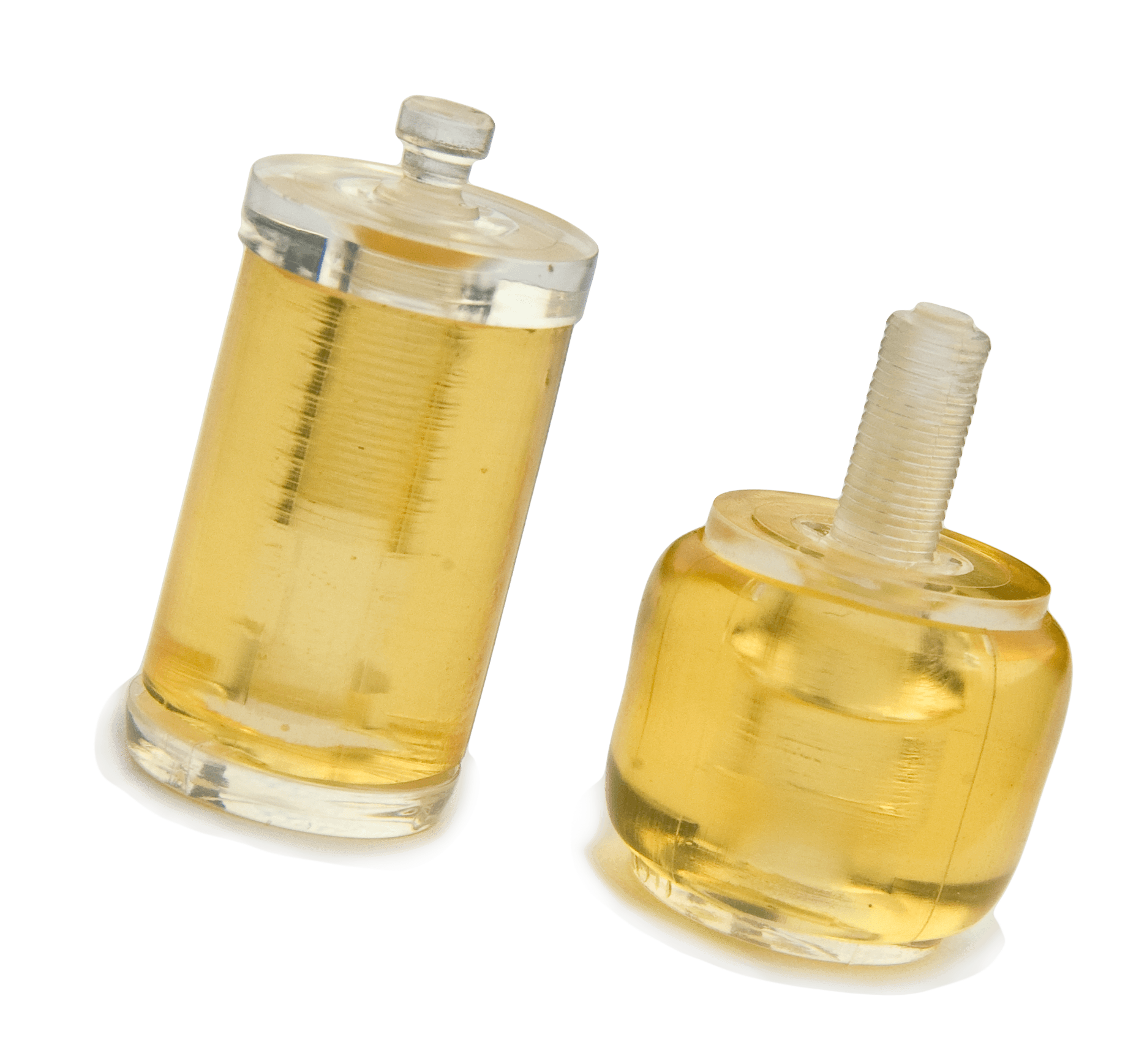
The REX Cement Stop is more than a cement restrictor. It is a cement stop, absolutely sealing the intramedullary canal before bone cement is inserted during hip replacement surgery.
No cement leakage
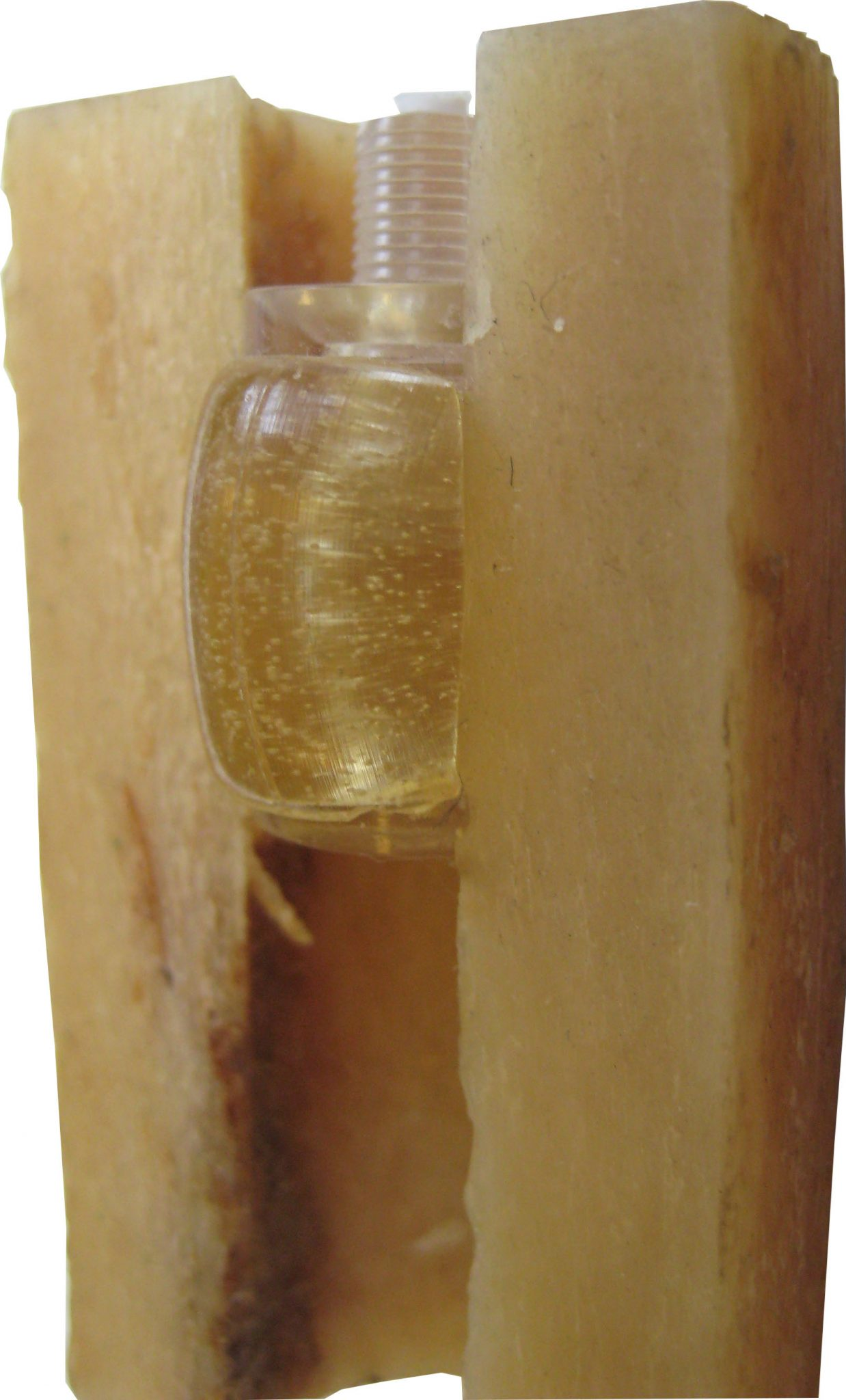
Due to its unique design, the REX Cement Stop ensures an optimal performance. As a result of the expandability of the gelatin bushings, the REX Cement Stop adapts to any irregular shape and forms a press fit within in the intramedullary canal. The REX Cement Stop prevents cement leakage.
Resists high cement pressures without migration
To achieve maximal interface strength, an optimal penetration of cement into the trabecular bone is needed. This increases the longevity of the joint reconstruction. The pressure needed to achieve this penetration demands a considerable level of resistance of the implanted cement restrictor. The REX Cement Stop can resist high pressures with limited migration and therefore enables optimal cement penetration.
Biocompatible material at revision
The REX Cement Stop features a new, advanced technology with materials that are proven to be effective in thousands of patients:
- Resorbable gelatin bushings: the traditional gelatin used in the bushings is highly biocompatible and resorbs fully within 2 weeks.
- The serrated pin, washer and locking rings are made of PMMA. The locking device will integrate with the PMMA cement mantle, assuring easy removal during revision.
Different sizes cover all diameters
An exact, time consuming measurement of the intramedullary canal diameter is usually not necessary. The REX Cement Stop expands and adapts fully to any irregularity of the intramedullary canal, enabling surgeons to easily select the appropriate size. There are five different sizes of REX Cement Stop, covering all diameters from ø 9 to ø 19 mm.
Safety mechanism
The REX Cement Stop has a built-in safety mechanism. When the maximal allowable pressure on the femur has been reached, the coupling head of the cement stop will break off.
Can be installed distally to the isthmus
The REX Cement Stop is inserted in its initial shape and can be inserted below the isthmus, because of its expandability after passing the narrow isthmus.
The REX Cement Stop is developed and manufactured by Spierings Orthopaedics BV, Nijmegen, the Netherlands. The REX Cement Stop is available in different sizes and equipped with specific instrumentation:
Product Article number
REX Cement Stop ø 9 REX-0709-9
REX Cement Stop ø 10 REX-0709-10
REX Cement Stop ø 11.5 REX-0709-11.5
REX Cement Stop ø 13.5 REX-0709-13.5
REX Cement Stop ø 16 REX-0709-16
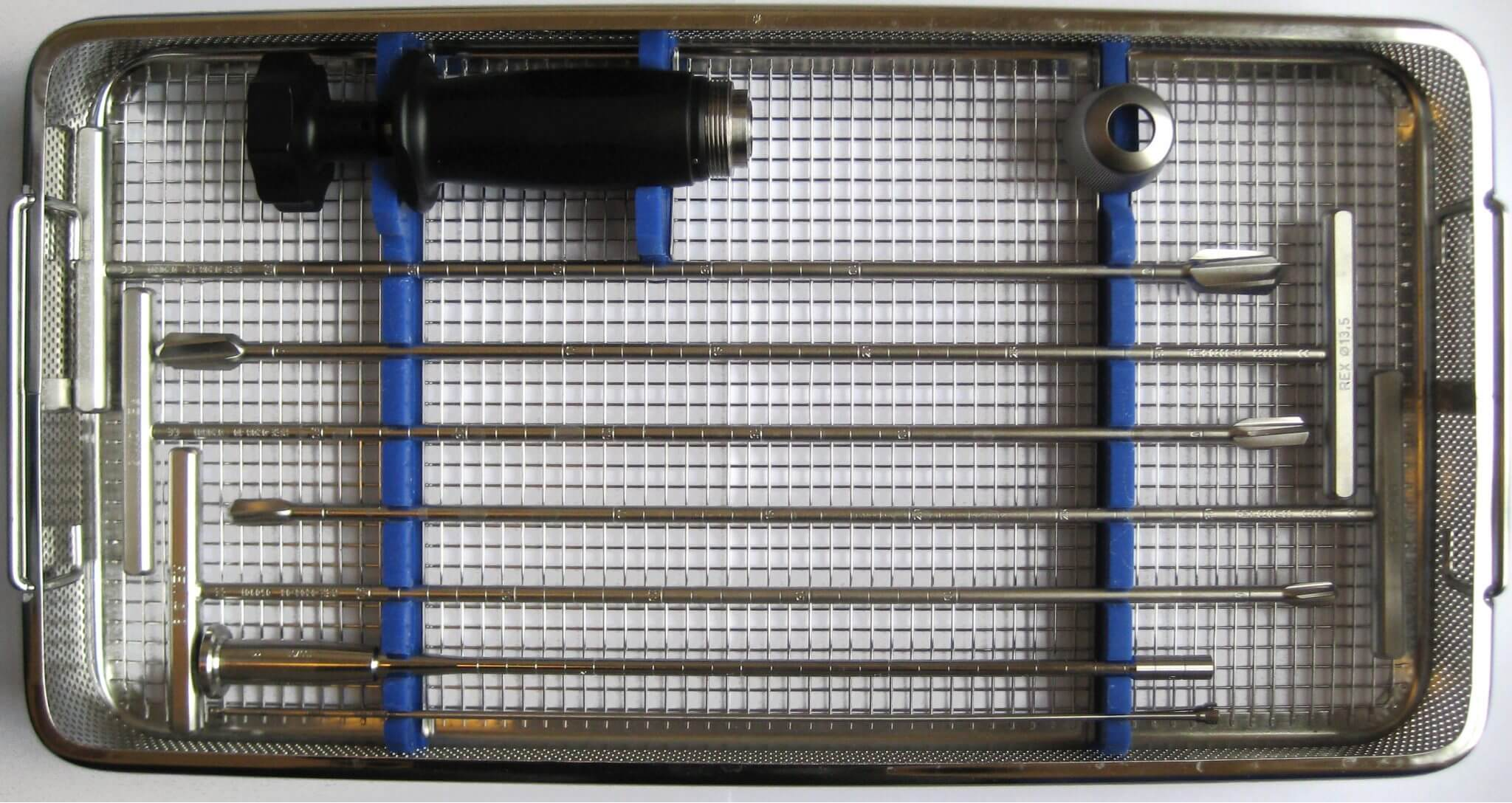
REX Insertion Instrument:
REX Hand Piece REX-0601-03-A
REX Screw Nut REX-0601-03-B
REX Inner Rod REX-0601-03-C
REX Outer Tube REX-0601-03-D
REX Reamer 9 REX-0208-08
REX Reamer 10 REX-0208-09
REX Reamer 11.5 REX-0208-10
REX Reamer 13.5 REX-0208-11
REX Reamer 16 REX-0208-12
REX Sterilization Tray REX-0802-02
What is the function of an intramedullary cement restrictor?
An intramedullary cement restrictor is used to seal the intramedullary femoral canal of patients requiring a cemented hip prosthesis.
Why should the intramedullary canal be sealed off?
Sealing off the intramedullary canal enables you to put pressure on the bone cement inserted prior to femoral stem placement. Additionally, a cement restrictor prevents distal leakage of bone cement.
Why should the bone cement be pressurized?
Pressure on the injected bone cement will lead to a better penetration of the bone cement into the surrounding cancellous bone. This will lead to a stronger interface between the host bone and the inserted bone cement, which will increase the longevity of the implant.
How much pressure can the REX Cement Stop resist?
In laboratory testing the REX Cement Stop has proven to resist hydrostatic pressures up to 10 bar. This means that no distal migration occurred before pressures of 10 bar had been reached.
How much pressure does the REX Cement Stop put on the surrounding bone?
Laboratory testing has proven that, because of the built-in safety mechanism, the pressure of the REX Cement Stop on the surrounding bone is limited to a maximum of 25 bar (depending on the amount of expansion of the gelatin). However, the actual pressure that the gelatin has on the femoral bone is lower than 25 bar. The moment the coupling head snaps off, the pressure on the femoral bone can be maximally 25 bar. As soon as this maximum femoral wall pressure has been reached, the head of the REX Cement Stop snaps off. This results in relaxation of the tightened locking mechanism, which results in a wall residual pressure of the femoral bone of 5 to 7 bar. With reference to the critical pressure of 24 bar – the maximum pressure that can be put on the femoral shaft before fractures occur – the REX Cement Stop is completely safe.
What should the surgeon do in case he estimates that a lower pressure is adequate (e.g. in case of severe osteoporosis)?
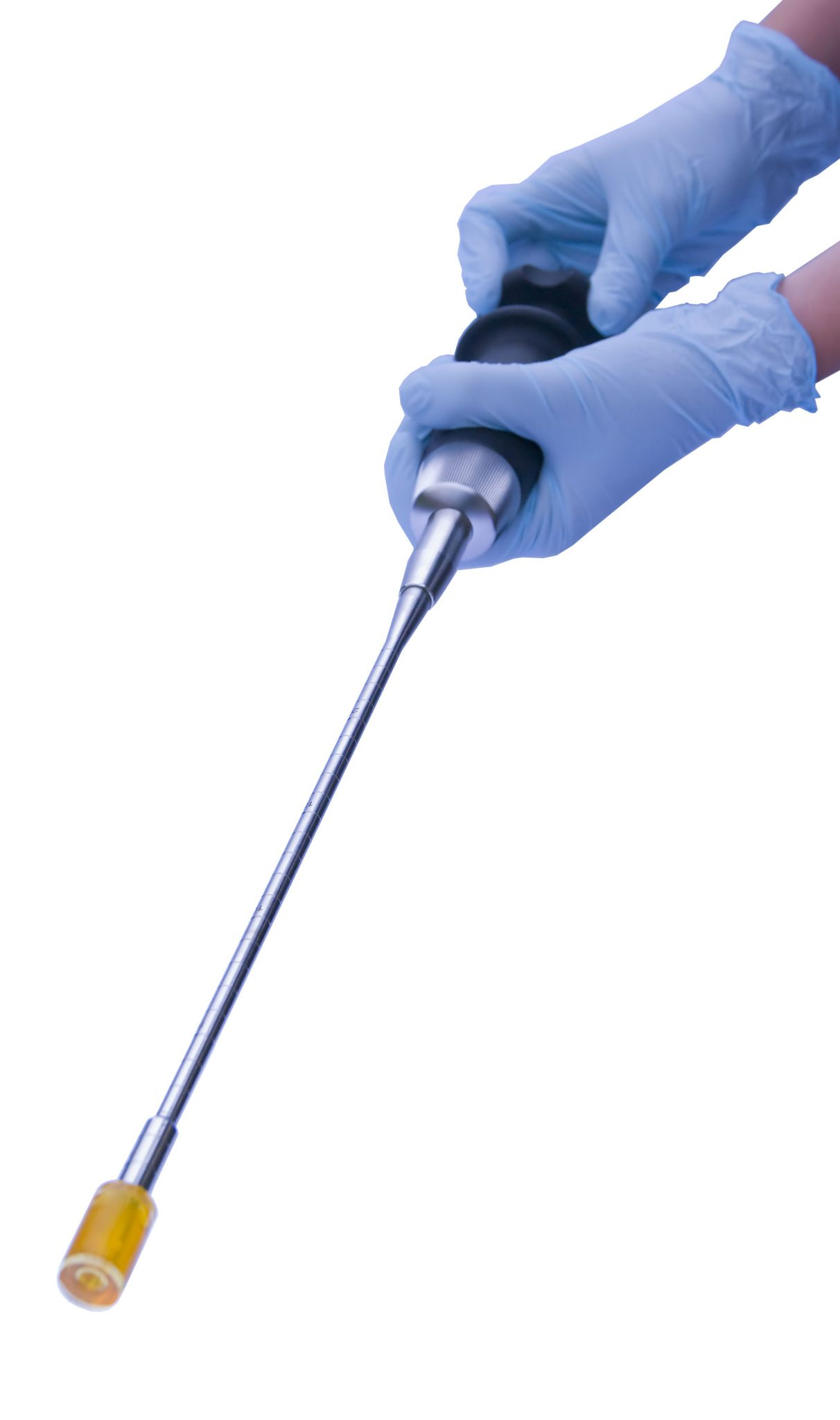
The REX Cement Stop has a safety mechanism to prevent the pressure on the surrounding bone to become too high. Should the surgeon estimate that a lower pressure is needed, the surgeon should release the knob of the insertion instrument before the head of the REX Cement Stop snaps off.
How does the safety mechanism work?
When maximum pressure of the gelatin bushings on the femoral wall has been reached, the force needed to rotate the knob of the insertion instrument will sharply rise. If the knob is turned further, the coupling head of the REX Cement Stop will snap off. The coupling head of the cement stop will remain inside the insertion instrument and the REX Cement Stop will be left in situ.
Is the REX Cement Stop radiopaque?
No. No X-ray markers or radiopaque agents have been used in the REX Cement Stop.
Can you see the REX Cement Stop on an X-ray photo?
Yes, indirectly. The bone cement shows the contour of the top of the REX Cement Stop, which is not radiopaque. Also, there is no leakage of bone cement (which is radiopaque) distally from where the REX Cement Stop has been positioned, so you can indirectly see the REX Cement Stop on an X-ray and verify that it has functioned correctly, see figure on the right.
Are the materials of the REX Cement Stop biocompatible?
Yes, both materials (the gelatin of the bushings and the PMMA of the locking mechanism) are widely accepted as biocompatible implant material. They are both accepted to be non-toxic and non pyrogenetic. PMMA is also used in bone cement and the PMMA parts of the REX Cement Stop bond to bone cement. The gelatin used in the bushings is fully degradable and will be absorbed within 2 weeks time.
Can the REX Cement Stop easily be removed in case of revision?
The flexible bushing will fully resorb within 2 weeks time. The PMMA bonds to the bone cement. Therefore, in case of a revision, the REX Cement Stop will be removed together with the bone cement.
How to remove the REX Cement Stop during surgery (e.g. in case the REX Cement Stop has been wrongly positioned)?
The REX Cement Stop can be removed by breaking the locking ring of the REX Cement Stop, for instance with a sharp chisel.
How is it prevented that the REX Cement Stop is positioned in the wrong place?
Prior to insertion, the surgeon should measure the length of the prosthesis’ stem using the measurement indications on the instrument and the reamers. Please make sure that the tip of the stem is at the 0-marking on the instrumentation, see Surgical Technique.
Can the REX Cement Stop be used in all sizes of intramedullary canals?
No, the use is limited to canals with a diameter between ø 9 and ø 19 mm:
| Size | Diameters covered: |
| ø 9 | 9 – 10 mm |
| ø 10 | 10 – 11.5 mm |
| ø 11.5 | 11.5 – 13.5 mm |
| ø 13.5 | 13.5 – 16 mm |
| ø 16 | 16 – 19 mm |
Is it always necessary to measure the canal prior to insertion?
Yes, the canal diameter can be determined by using the REX reamers before inserting the cement plug. The canal is not really measured but by using the reamers with a rotating motion it is ensured that no bone particles locally obstruct or narrow the femoral canal.
Which plug size should be used when a surgeon is in doubt?
The surgeon should choose the largest plug size of the largest REX reamer that can be reamed into the canal.
Should the REX Cement Stop be stored in a refrigerator?
No, the REX Cement Stop should be stored in a dry room at room temperature, see the product information.
Is there a risk for BSE (Bovine Spongiform Encepholapathy) in the gelatine used in the bushings of the REX Cement Stop?
No, there is no risk for BSE. BSE is only found in bovine material. The gelatine of the REX Cement Stop is derived from pig skin. Additionally, BSE is never found in the skin of any animal. This excludes the risk for BSE.
Is there an increased risk of embolism using the REX Cement Stop?
No. Studies in fresh frozen bone by Prof. C. Heisel at the University of West-Virginia, Morgantown, has shown that inserting cement restrictors (especially oversized restrictors) leads to more extrusion of debris into the circulation. The REX Cement Stop will be inserted in its initial (small) shape and will expand locally. This means that there is no pressure on the intramedullary canal during insertion. This results in a risk of embolism that is lower than with commonly used cement restrictors.
Will the surrounding bone be influenced by the expansion of the REX Cement Stop?
No, for two reasons: (1) the pressure exerted by the REX Cement Stop on the surrounding bone is of a very short duration, because the gelatin bushing resorbs quickly and (2) at the time of expansion, the pressure will be maximally 25 bar on the femoral wall. As soon as this maximum has been reached, the head of the REX Cement Stop snaps off. This results in a slight relaxation of the tightened locking mechanism, and the wall pressure drops immediately to 5 – 7 bar.
Can the REX Cement Stop be used in other joints as well?
No, pressures on the bone have only been tested and proven in the proximal femoral canal.
Downloads
References
Abstract by D. Pratt, R. Mootanah, J Dowell Journal of Bone and Joint Surgery supplement (Br) 2005: Vol 87-B, Issue Supp I,49.